
 11
11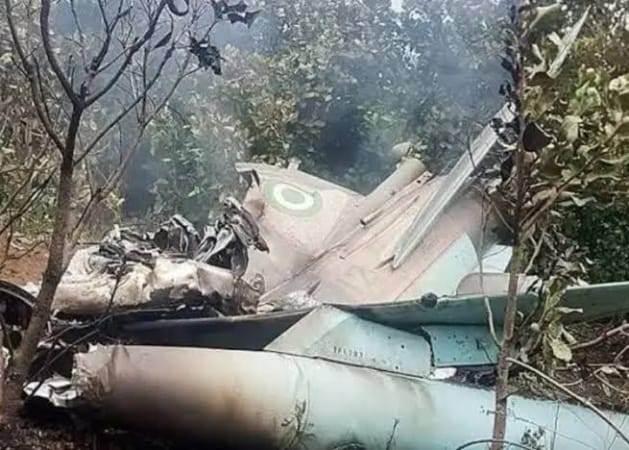


Residents of Igbokoda, Ondo State, have raised the alarm over offensive odour, floating human remains and possible environmental contamination more than a week after a Nigerian Air Force aircraft crashed into a swamp in the community.
The residents have appealed to the Federal and Ondo State governments, as well as the Nigerian Air Force (NAF), to urgently evacuate the remaining human remains, clean up the affected environment and provide safe drinking water to prevent possible public health risks.
The NAF ATR-42 aircraft, which was flying from Benin City to Lagos, crashed into a swamp near the Air Force Forward Operating Base in Igbokoda on October 5, killing all 25 people on board, comprising five crew members and 20 passengers.
The aircraft reportedly submerged in the swamp, prompting a joint search and recovery operation involving the Air Force, other security agencies and emergency responders.
However, community leaders say the recovery operation has yet to yield the desired results, leaving residents concerned about the environmental and health implications of the incident.
The Olu of Igbokoda, Oba Afolabi Odidiomo, said decomposing human remains and suspected aviation fuel spillage had worsened conditions around the crash site.
According to the monarch, the offensive odour has spread to residential areas, while human body parts are reportedly still floating in the river.
“The odour is extremely offensive and unbearable. So many parts of human bodies are floating around in the river. Some of the bodies have not been recovered; they have decomposed, and it is affecting everything,” he said.
Odidiomo expressed concern that the situation could contaminate the river, which residents rely on for domestic purposes.
He called for the immediate recovery of the remaining human remains and aircraft debris, containment of any fuel spillage and comprehensive environmental clean-up.
The monarch also urged the authorities to provide potable water to residents while efforts to restore the affected environment continue.
Residents living close to the river also described the situation as distressing, citing the persistent odour since the accident.
One of them, Omogbemi Damola, said the smell had been carried by the breeze into residential buildings for several days.
“What happened in Igbokoda is a very sad experience. Since the accident occurred, different kinds of unpleasant odours have been carried by the breeze into our homes. I live upstairs, and I have been perceiving the smell for at least four days now,” he said.
Another resident, Oroyo Levy, described the situation as a public health concern, urging the government to take immediate steps to contain the odour and assess its possible effects on the community.
“We are appealing to government to act swiftly to contain the odour and prevent it from posing further health risks. The smell suggests air pollution, and we are worried about its effect, especially on children,” he said.
The residents also called on the National Emergency Management Agency, the State Emergency Management Agency and relevant environmental authorities to intervene and assess the risks of water contamination and possible disease outbreaks.
Reacting to the concerns, Ondo State Commissioner for Environment, Tob Loko, said the state government was working with the Federal Government to maximise the recovery of human remains from the crash site.
He, however, acknowledged that the recovery operation had yet to produce significant results.
“The state government is collaborating with the Federal Government to ensure that we carry out as much recovery as possible. But you know that despite the number of days the recovery effort has been ongoing, no meaningful recovery has been made. None of the corpses has been recovered,” Loko said.
He explained that the government was undertaking a comprehensive assessment of the potential public health implications of the incident to determine the appropriate environmental clean-up measures.
“What we are trying to do is make a holistic assessment of the level of public health impact and determine how we can embark on decontamination efforts because the surrounding area is surely contaminated,” he added.
On concerns that the crash might have compromised residents’ access to drinking water, the commissioner said the claim was not entirely accurate, noting that boreholes were available in the area and that the crash site was at least 500 metres from the main residential area.
“There are boreholes around. So, the claim that the water is no longer useful is not entirely correct. To say that the people do not have water to drink as a result of the crash is not a sustainable argument,” he said.
Despite the commissioner’s clarification, residents are calling for urgent recovery and environmental assessment measures to address their concerns and ensure the safety of the affected community.