
 11
11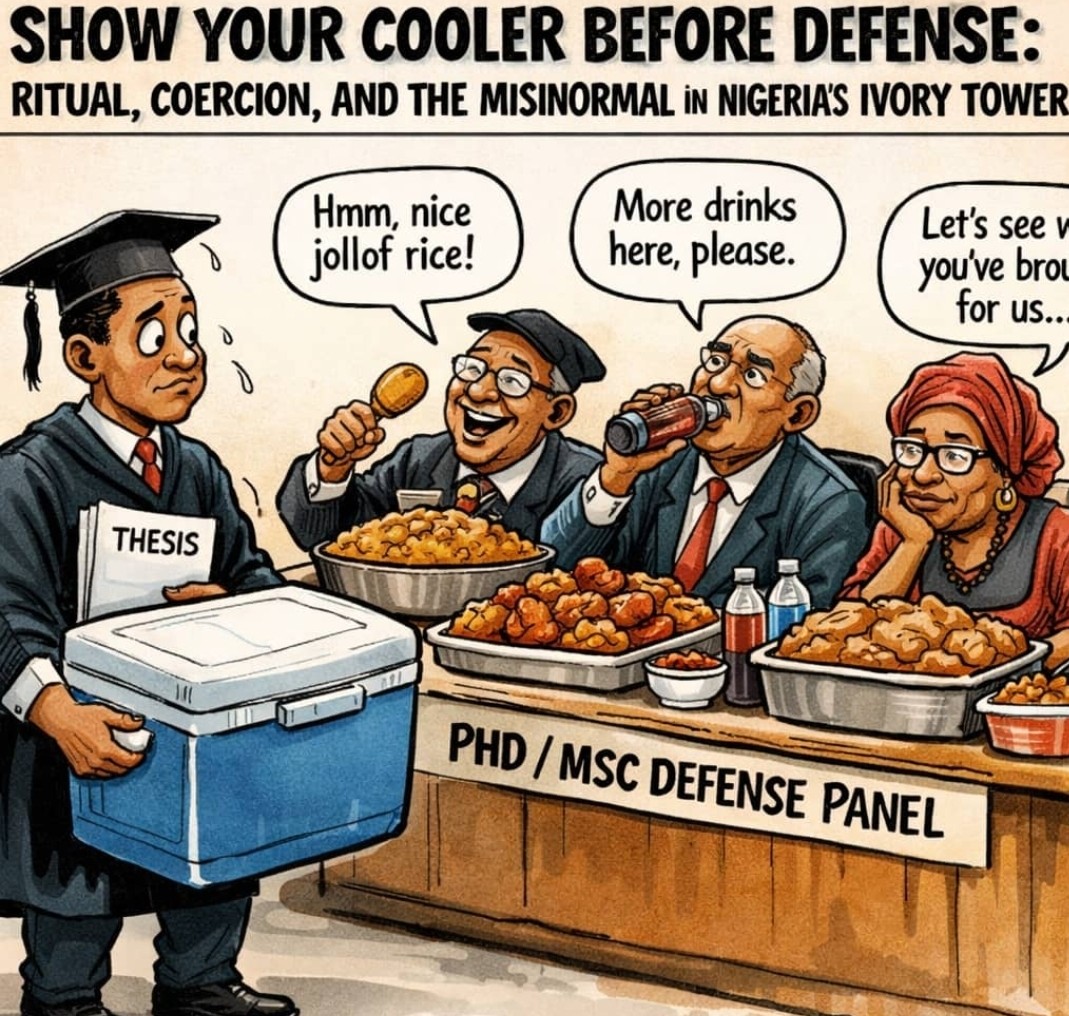


In this piece, Prof Adeyemi Ademowo argues that Nigeria’s universities face ethical decline as “defense list” practices compel postgraduate students to provide food and drinks for examiners, transforming thesis defense into a coercive, costly ritual that undermines academic integrity, fairness, and the credibility of the evaluation process.
Sometime in late 2025, during a conversation with a colleague teaching at a federal university in Southwest Nigeria, an unsettling phrase came up: “defense list.” At first, it sounded harmless—perhaps just another administrative requirement. But a closer look reveals a troubling practice that deserves urgent scrutiny.
Two issues emerged from that discussion. The first was the growing commodification of academic work, where analysts increasingly “assist” postgraduate students by producing key sections of their theses. That concern, though serious, requires deeper investigation.
The second issue is more immediate, visible, and arguably more dangerous in how widely it has been normalized across MSc and PhD programmes.
Universities are meant to be spaces of intellectual rigor, ethical discipline, and critical thinking. They must resist practices that reduce academic milestones to transactional exchanges. A thesis defense—whether for PGD, MSc, MPhil, or PhD—is not a social event. It is a serious intellectual exercise meant to test the originality and quality of research
It is what I describe as the “show your cooler before defense” culture.
In some Nigerian universities, postgraduate students are now given a mandatory “defense list.” But this list has nothing to do with academic standards or intellectual preparation. Instead, it itemizes food and drinks—pounded yam, rice dishes, assorted meats, and crates of beverages. In certain cases, a student’s defense date is not even scheduled until these items are provided.
This raises a fundamental question: when did academic rigor become dependent on catering arrangements?
What may once have been a voluntary gesture of appreciation has now become an unwritten requirement. It is no longer hospitality—it is expectation. And when expectations are tied to academic progression, they easily become a form of quiet coercion.
The ethical concerns are significant.
First, it undermines fairness and the integrity of academic evaluation. How can assessment remain impartial when candidates are required to provide food for the very panel judging them? Even if no bias occurs, the perception alone damages trust in the process. A system that allows such overlap invites suspicion—and suspicion erodes institutional credibility.
Second, it places an additional burden on students who are already financially strained. In Nigeria, most postgraduate programmes are self-funded. Students shoulder tuition, research expenses, and basic living costs, often with little or no institutional support. Many are unemployed or underemployed, pursuing higher degrees in uncertain economic conditions.
To impose extra, non-academic costs under the guise of tradition is not only insensitive—it is exploitative.
Third, and perhaps most concerning, is how this practice is becoming normalized. What begins as an exception gradually becomes routine. Over time, what was once questioned becomes accepted. This is how institutions decline—not through sweeping changes, but through the quiet acceptance of small ethical compromises.
Some may argue that such practices promote collegiality or reflect cultural values of hospitality. But culture must not be used to justify unethical behavior. Hospitality, by its nature, must be voluntary. A gift that is demanded is no longer a gift.
Universities are meant to be spaces of intellectual rigor, ethical discipline, and critical thinking. They must resist practices that reduce academic milestones to transactional exchanges. A thesis defense—whether for PGD, MSc, MPhil, or PhD—is not a social event. It is a serious intellectual exercise meant to test the originality and quality of research.
Anything that compromises—or appears to compromise—that standard should be rejected.
This is not an argument against celebration. Departments may organize optional, collectively funded post-defense gatherings that do not place the burden on individual students. More importantly, institutions should begin to explore structured funding support for postgraduate education, however modest.
But the current trend—where a “defense list” becomes a prerequisite for academic evaluation—is unacceptable and must be addressed.
If left unchecked, we risk raising a generation that believes success is achieved not only through merit, but through material appeasement.
That would be a far more dangerous outcome than any failed thesis.
As the Yoruba proverb warns: àṣà tí a kò bá tọ́ lẹ́sẹ̀sẹ̀, á máa bàjẹ́ ní ọwọ́ ẹni—a culture that is not carefully guided will decay in our hands.
The “cooler before defense” culture has no place in our universities. It must be questioned, resisted, and ultimately dismantled.
Mo wi t’emi o. Ire o.
Ademọwọ is a Professor of Social Anthropology
and African Studies in the Department of Sociology, Afe Babalola University