Litigation
Sowore suffers fresh setback as court orders him to open defence in cybercrime trial

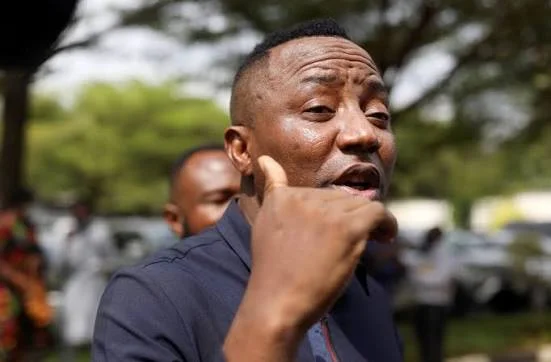
The Federal High Court in Abuja has dismissed another application by human rights activist and African Action Congress (AAC) presidential candidate, Omoyele Sowore, in his cybercrime trial over his description of President Bola Tinubu as a “criminal”, directing him to open his defence.
In a ruling on Monday, Justice Mohammed Umar set aside a subpoena earlier issued against Akinlolu Kehinde, SAN, counsel to the Department of State Services (DSS), thereby rejecting the defence’s attempt to compel the senior lawyer to testify in the case.

The judge held that legal practitioners owe their clients a strict duty of confidentiality and cannot ordinarily be compelled to disclose communications or matters relating to their professional engagement.
He explained that a lawyer could only be required to testify in limited circumstances, particularly where the evidence sought concerns an uncontested matter or an issue whose disclosure would not prejudice the client’s interests.
The ruling followed an application by Sowore’s defence team seeking to have Kehinde testify, apparently as part of its effort to challenge aspects of the prosecution’s case.
The cybercrime proceedings arose from Sowore’s description of President Tinubu as a “criminal” in a social media publication, an expression the DSS considered offensive and constituting cyberbullying.
The secret police subsequently instituted criminal proceedings against the activist, maintaining that his publication violated the law and warranted prosecution.
Sowore, however, has consistently challenged the legality and propriety of the proceedings, filing several applications to terminate the trial and contesting the prosecution’s evidence.
The DSS has maintained its determination to establish the allegations against him, presenting evidence and witnesses in support of its case.
Following Monday’s ruling, defence counsel, R.O. Adakole, informed the court of the team’s intention to subpoena the Chairman of the Independent National Electoral Commission (INEC), Professor Joash Amupitan, and an All Progressives Congress (APC) chieftain, Chief Joe Igbokwe, as defence witnesses.
Justice Umar granted the application and ordered that subpoenas be issued to the two proposed witnesses.
The court subsequently adjourned the matter until November 11, 2026, for their appearance.
Monday’s decision is the latest in a series of unfavourable rulings against Sowore since the commencement of the trial.
In mid-October, the court rejected a similar attempt by the defence to compel the DSS Director-General, Oluwatosin Ajayi, to testify on the activities of the agency in connection with the case.
Upholding a counter-application by the DSS, Justice Umar ruled that another senior official of the agency could testify on the Director-General’s behalf. Consequently, Michael Jego, an investigating officer with the DSS, was nominated to represent the agency.
Earlier, on May 8, 2026, the judge dismissed Sowore’s no-case submission, holding that the prosecution had adduced sufficient evidence to establish a prima facie case requiring him to enter his defence.
The ruling followed the conclusion of the DSS’s presentation of evidence and its insistence that the case should proceed, despite the defence’s argument that the prosecution had failed to establish sufficient grounds for requiring Sowore to answer the allegations.
A no-case submission is an application by an accused person asking the court to terminate a trial on the ground that the prosecution has failed to adduce evidence linking the defendant to the alleged offence or otherwise establish a case requiring an answer.
The court had also earlier dismissed Sowore’s preliminary objection challenging the legality of the trial and rejected his application seeking to terminate the proceedings on the grounds of alleged violations of his fundamental human rights.
In another ruling delivered on April 2, Justice Umar refused all three reliefs sought by Sowore in a fundamental rights enforcement suit instituted against the DSS, its Director-General and Meta Corporation, owners of Facebook and X.
The judge held that freedom of expression did not confer an unrestricted licence to make statements capable of casting aspersions on others.
“The law will frown at any expression that will cast aspersion on others in the name of expressing the constitutional right to freedom of expression,” he ruled.
He consequently awarded N1.5 million in costs against Sowore, comprising N500,000 each in favour of the three respondents.
On June 22, 2026, Justice Umar ordered Sowore’s remand at the Kuje Correctional Centre, Abuja, a week after revoking his bail. The judge had also rejected the activist’s application asking him to recuse himself over allegations of bias.
With the latest ruling, Sowore is expected to proceed with his defence, while the appearance of the two subpoenaed witnesses could shape the next phase of the proceedings.




INEC expunges 1.6m irregular voter records, identifies 54 officials for prosecution

Sowore suffers fresh setback as court orders him to open defence in cybercrime trial

Why NJC cannot impose seniority in Imo CJ appointment—Udemezue

Imo Chief Judge: Why NJC’s oversight powers matter, by Kunle Kalejaye

2027 Polls: HURIWA warns 375 election judges against selling justice

CJN swears in 2027 election petition tribunal members
Imo AG faults NJC directive on Chief Judge shortlist

Counterfeit products: A deadly trade claiming Nigerian lives, by Kazeem Akintunde

Tinubu’s ‘ex-lecturer’ raises fresh questions over Chicago varsity education

ADC will contest 2027, but Atiku may be excluded – Keyamo

Sanction of Judges: NJC on quiet revolution to cleanse judiciary—Prof Akinseye-George, SAN
BREAKING: NJC recommends 28 for judicial appointments, suspends three judges
5,000 academics to endorse Tinubu’s re-election bid in November
Tinubu appoints ex-DSS DG Yusuf Bichi NISS Governing Board Chairman

Presidency seeks private sector funding for state Police

Agbakoba, Ojo, Etomi, three others to receive Gavel Lifetime Achievement Awards

Media Trust Group to launch AI-powered converged digital Newsroom

Opene v NJC: That S’Court landmark ruling on NJC’s disciplinary powers over judges, by Ebun-Olu Adegboruwa,SAN

Does Nigeria truly have over 103 million voters, asks Prof Chidi Anselm Odinkalu

Ex-DSS officer apologises to DG over leaked memo, threatens lawsuit against SaharaReporters
-
 FeaturedMay 2 2025
Sanction of Judges: NJC on quiet revolution to cleanse judiciary—Prof Akinseye-George, SAN
-
 FeaturedNovember 4 2026
BREAKING: NJC recommends 28 for judicial appointments, suspends three judges
-
 FeaturedNovember 3 2026
5,000 academics to endorse Tinubu’s re-election bid in November
-
General NewsOctober 23 2026
Tinubu appoints ex-DSS DG Yusuf Bichi NISS Governing Board Chairman
-
 NewsOctober 28 2026
Presidency seeks private sector funding for state Police
-
 Bar and BenchOctober 23 2026
Agbakoba, Ojo, Etomi, three others to receive Gavel Lifetime Achievement Awards
-
 NewsOctober 18 2026
Media Trust Group to launch AI-powered converged digital Newsroom
-
 FeaturedOctober 27 2026
Opene v NJC: That S’Court landmark ruling on NJC’s disciplinary powers over judges, by Ebun-Olu Adegboruwa,SAN