Bar and Bench
Nigerian-trained Dapo Akande elected to World Court, joins distinguished league of Nigerian legal giants

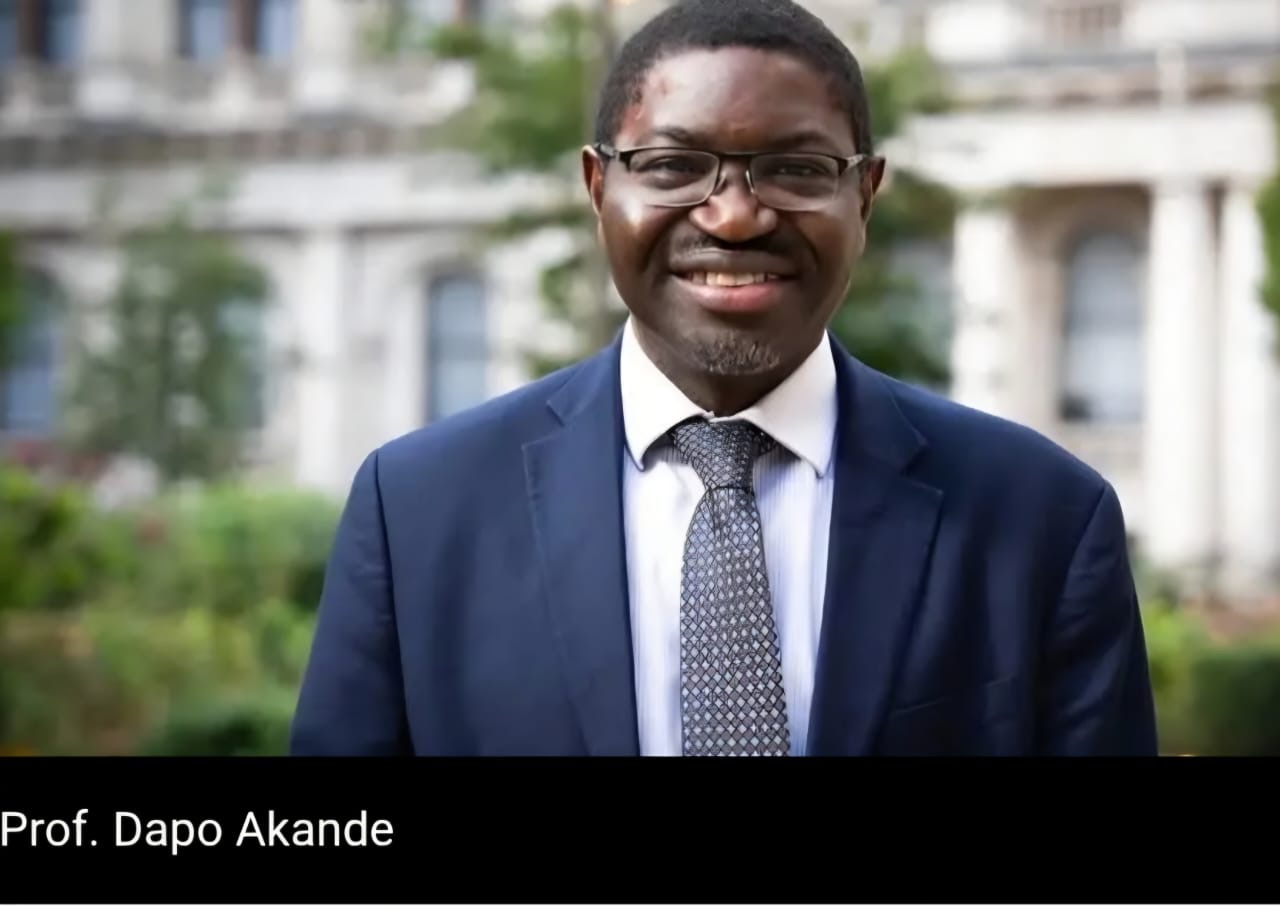
Professor Dapo Akande, a Nigerian-born and trained international law scholar, has been elected a judge of the International Court of Justice (ICJ), the principal judicial organ of the United Nations, in a development that has again drawn international attention to Nigeria’s contributions to the advancement of international law.
Akande was elected on Tuesday, November 3, 2026, as the United Kingdom’s candidate for a nine-year tenure on the 15-member World Court, becoming the first British judge to secure a seat on the court since 2018.

He will formally assume office on February 6, 2027.
His election is particularly significant against the background of Nigeria’s distinguished history of producing internationally acclaimed jurists who have occupied positions of influence at the Hague-based court, including the late Justices Charles Dadi Onyeama and Taslim Olawale Elias, as well as Prince Bola Ajibola, a former Attorney-General of the Federation and Minister of Justice.
Although Akande’s election was secured under the British nomination, his Nigerian roots, legal training and professional background represent another significant recognition of the intellectual contributions of Nigerian-trained lawyers to international legal scholarship and practice.
Nigeria’s distinguished history at the World Court
Nigeria’s association with the ICJ dates back to 1967 when Justice Charles Dadi Onyeama became the first Nigerian to serve as an elected judge of the international judicial institution.
Onyeama, who served from 1967 to 1976, was a distinguished jurist whose appointment came barely seven years after Nigeria gained independence.
His elevation to the World Court marked an important milestone in the country’s participation in the international legal system, demonstrating that Nigeria could produce jurists capable of contributing to the resolution of complex disputes between sovereign states.
His tenure also helped establish Nigeria’s presence in the international judicial community at a period when newly independent African countries were seeking greater recognition and participation in global institutions.
He was succeeded by another eminent Nigerian jurist, Justice Taslim Olawale Elias, whose contribution to international jurisprudence arguably remains one of the most remarkable achievements by an African legal scholar.
Elias, who was elected to the ICJ in 1975, had earlier served as Nigeria’s first Attorney-General and Minister of Justice, Chief Justice of Nigeria and a distinguished professor of law.
His international judicial career was particularly remarkable. He served as Vice-President of the ICJ between 1979 and 1982, Acting President between 1981 and 1982, and subsequently President of the court from 1982 to 1985, becoming the first African to occupy the prestigious position.
His elevation to the presidency of the World Court was not only a personal achievement but also a landmark for Nigeria and the African continent, demonstrating that African jurists could attain the highest levels of authority in international judicial institutions.
Beyond his judicial responsibilities, Elias made enduring contributions to the development of international law through his extensive scholarship, particularly in the areas of African customary law, international legal relations and the evolution of the modern international legal order.
His intellectual contributions and international reputation helped place Nigerian legal scholarship on the global map.
Another Nigerian whose contribution to the World Court deserves particular recognition is Prince Bola Ajibola, SAN, who was elected a judge of the ICJ on December 5, 1991, following the death of Elias in August of that year.
Ajibola, who had previously served as Nigeria’s Attorney-General and Minister of Justice between 1985 and 1991 and as President of the Nigerian Bar Association, served on the court until February 1994.
His subsequent involvement in the landmark Cameroon-Nigeria territorial dispute further demonstrated his commitment to defending Nigeria’s legal and territorial interests before the international community.
Appointed as Nigeria’s judge ad hoc in the proceedings concerning the land and maritime boundary dispute between Nigeria and Cameroon, Ajibola participated in the court’s consideration of the contentious Bakassi Peninsula and Lake Chad boundary questions.
In its October 10, 2002 judgment, the ICJ ruled largely in favour of Cameroon’s territorial claims, including sovereignty over the Bakassi Peninsula.
Ajibola, however, delivered a dissenting opinion, challenging aspects of the court’s reasoning and arguing that insufficient consideration had been given to Nigeria’s historical evidence, treaties and the exercise of effective authority over the disputed territories.
His dissenting position remains an important part of the legal history of the Bakassi dispute and Nigeria’s engagement with international adjudication.
It also illustrates the role of a judge ad hoc, who participates in the proceedings of a particular case on equal judicial terms with other members of the court, although the appointment does not confer permanent membership.
Akande’s international legal credentials
Akande’s election comes against the background of an impressive career spanning nearly three decades in public international law.
He is currently the Chichele Professor of Public International Law at the University of Oxford, a Fellow of All Souls College and Co-Director of the Oxford Institute for Ethics, Law and Armed Conflict.
He is also a member of the United Nations International Law Commission and a practising barrister at Essex Court Chambers.
His academic career has included visiting appointments at leading institutions across the world, including Yale Law School in the United States and the University of Melbourne in Australia, where he was the Sir Ninian Stephen Visiting Scholar at the Asia-Pacific Centre for Military Law in 2015.
His areas of expertise include the law of international organisations, international humanitarian law, the laws of armed conflict, international criminal law, cyber operations and international dispute settlement.
Akande is also the author of Oppenheim’s International Law: The United Nations, published by Oxford University Press in 2017, which received the American Society of International Law’s Certificate of Merit in 2019.
He co-edited several influential publications, including The Oxford Guide to International Humanitarian Law (2020), Human Rights and 21st Century Challenges (2020) and Practitioners Guide to the Application of Human Rights Law in Armed Conflict (2016).
He was also part of the International Group of Experts responsible for producing the Tallinn Manual 2.0 on International Law Applicable to Cyber Operations in 2017.
Beyond academic research, Akande has participated in the Oxford Process on International Law Protections in Cyberspace, co-directed the Oxford Martin Programme on Human Rights for Future Generations between 2012 and 2017, and co-led the European Research Council project on the Individualisation of War between 2014 and 2019.
His practical experience includes appearing as counsel, advocate and expert before several international judicial and dispute-resolution institutions, including the ICJ, International Tribunal for the Law of the Sea, European Court of Human Rights, African Court on Human and Peoples’ Rights and International Criminal Court.
He has also advised governments and international organisations, including the United Nations, African Union Commission, Commonwealth Secretariat, Council of Europe and NATO.
In 2024, he was designated to the International Centre for Settlement of Investment Disputes panel of arbitrators by the President of the World Bank and subsequently appointed to ad hoc annulment committees.
Akande, who is also a founding editor of EJIL:Talk!, said he was honoured by the confidence reposed in him by member states.
He pledged to discharge his responsibilities with independence and impartiality.
“I pledge to serve with independence and to deciding cases on the basis of a faithful and impartial application of the law,” he said in a statement issued by the United Kingdom’s Foreign, Commonwealth and Development Office.
He added that he looked forward to contributing to the peaceful settlement of international disputes.
His election once again underscores the global relevance of Nigerian legal education and the contributions of Nigerian-trained legal professionals to international jurisprudence, even as his appointment will formally be under the United Kingdom’s representation at the World Court.




SAN Rank: NLS renews demand for publication of candidates’ scores, sparks transparency debate

Ibori loses £136m asset forfeiture appeal in UK, reignites questions over 2009 Nigerian acquittal

Nigerian-trained Dapo Akande elected to World Court, joins distinguished league of Nigerian legal giants

2027: Why I backed Tinubu in 2023 but now want to unseat him – Makinde

EFCC alleges Emefiele acquired billions in properties through proxies, collected $17m gratification

Six years after jumping bail, Maina’s son to begin seven-year jail term

FG scraps 269 obsolete laws, consolidates 663 enactments in proposed LFN 2025

2027 Polls: Electoral Act 2026, judiciary and the test of Nigeria’s democracy, by Ebun-Olu Adegboruwa, SAN

2027: Makinde accuses APC of stealing ideas from his nine-page manifesto as Tinubu unveils 109-page agenda

Imo APC Crisis: Uzodimma, Okorocha power struggle threatens Tinubu’s 2027 re-election chances

Sanction of Judges: NJC on quiet revolution to cleanse judiciary—Prof Akinseye-George, SAN

BREAKING: NJC recommends 28 for judicial appointments, suspends three judges

5,000 academics to endorse Tinubu’s re-election bid in November
Tinubu appoints ex-DSS DG Yusuf Bichi NISS Governing Board Chairman

Presidency seeks private sector funding for state Police

Agbakoba, Ojo, Etomi, three others to receive Gavel Lifetime Achievement Awards

Media Trust Group to launch AI-powered converged digital Newsroom

Opene v NJC: That S’Court landmark ruling on NJC’s disciplinary powers over judges, by Ebun-Olu Adegboruwa,SAN

Tinubu seeks Senate approval for fresh N10.79trn foreign loan amid debt controversy

Does Nigeria truly have over 103 million voters, asks Prof Chidi Anselm Odinkalu
-
 FeaturedMay 2 2025
Sanction of Judges: NJC on quiet revolution to cleanse judiciary—Prof Akinseye-George, SAN
-
 FeaturedNovember 4 2026
BREAKING: NJC recommends 28 for judicial appointments, suspends three judges
-
 FeaturedNovember 3 2026
5,000 academics to endorse Tinubu’s re-election bid in November
-
General NewsOctober 23 2026
Tinubu appoints ex-DSS DG Yusuf Bichi NISS Governing Board Chairman
-
 NewsOctober 28 2026
Presidency seeks private sector funding for state Police
-
 Bar and BenchOctober 23 2026
Agbakoba, Ojo, Etomi, three others to receive Gavel Lifetime Achievement Awards
-
 NewsOctober 18 2026
Media Trust Group to launch AI-powered converged digital Newsroom
-
 FeaturedOctober 27 2026
Opene v NJC: That S’Court landmark ruling on NJC’s disciplinary powers over judges, by Ebun-Olu Adegboruwa,SAN